Living Watercolour Engine
By commissionFractal mathematics, rendered as painting.
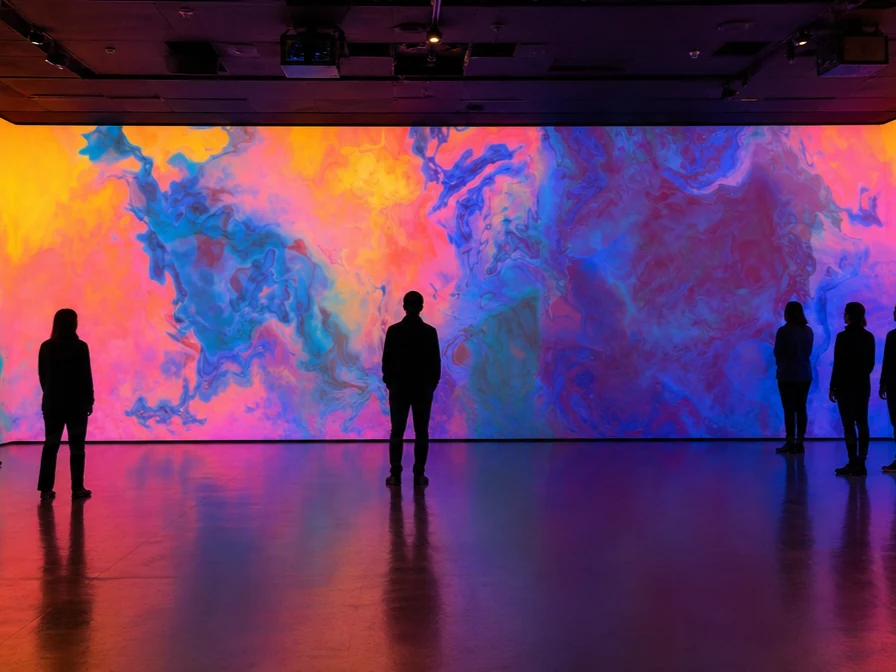
A custom GPU rendering engine that turns fractal structure into imagery which reads as watercolour and gouache rather than computer graphics. Built from the ground up for large-format, immersive work: ultra-wide canvases, seamless loops, and render times measured in seconds.
This engine is made available for commissioned work rather than sold as a product.
Off-the-shelf tools don't do this.
Conventional fractal software struggles with the things immersive work demands: extreme aspect ratios, resolutions large enough for multi-wall projection, and animation that loops perfectly for continuous display. It also tends to look unmistakably computed, carrying the rainbow-gradient signature of generated art.
- Ultra-wide, high-resolution output designed for panoramic and multi-wall projection from the outset.
- A painterly finishing stage that gives the mathematics the texture of traditional media.
- Perfect loops, with every parameter driven periodically so the first and last frame match exactly.
Mathematics in, paintings out.
GPU fractal rendering
A GLSL raymarching and shading pipeline built for speed at very high resolutions and extreme aspect ratios: seconds per frame, not hours.
Multiple fractal formulas
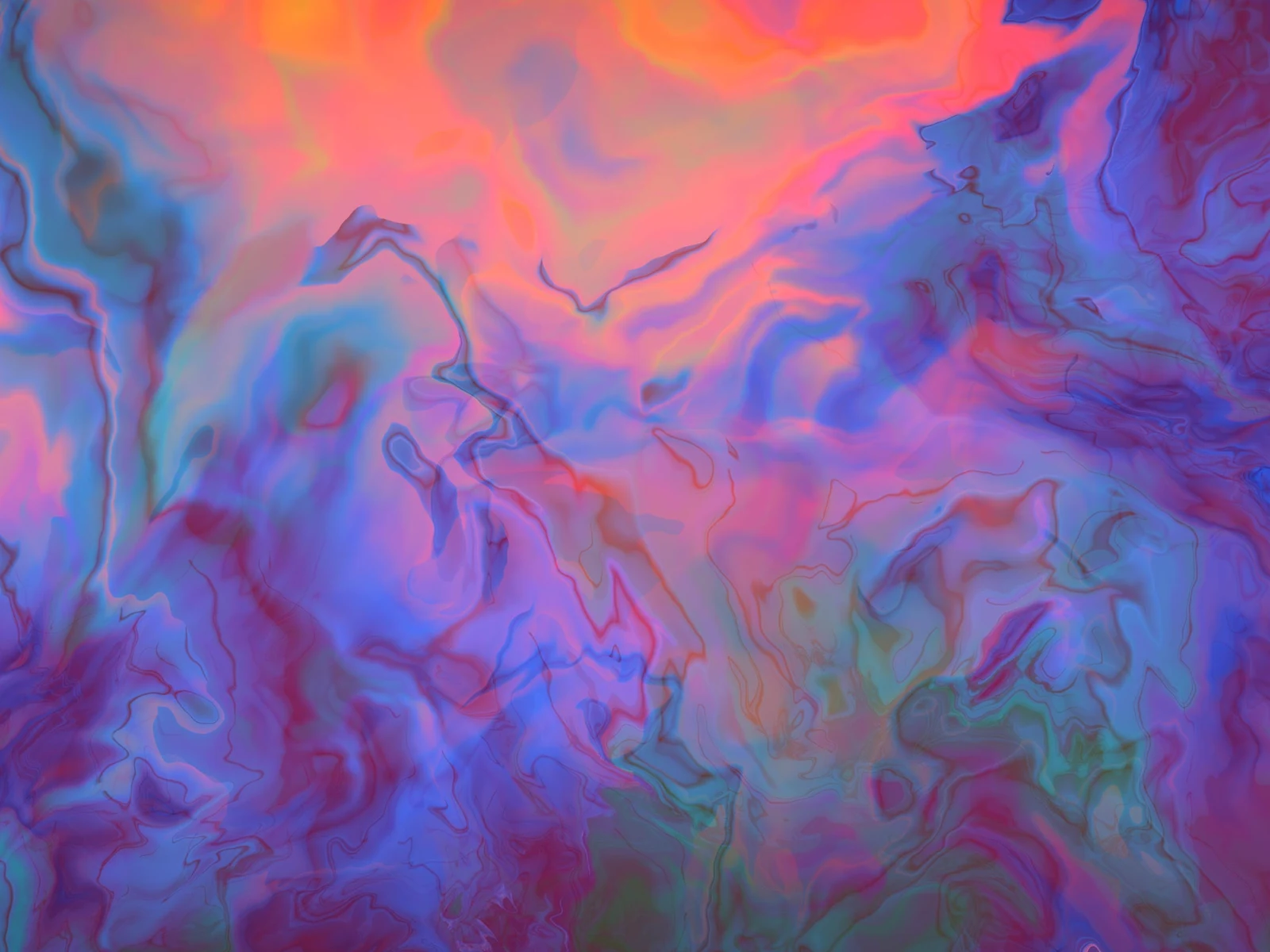
Julia sets, Mandelbrot, Burning Ship, Tricorn and Phoenix, blended with domain-warped flow fields to produce drifting veins, layered landscapes, plumes and textural fields.
Painterly finishing
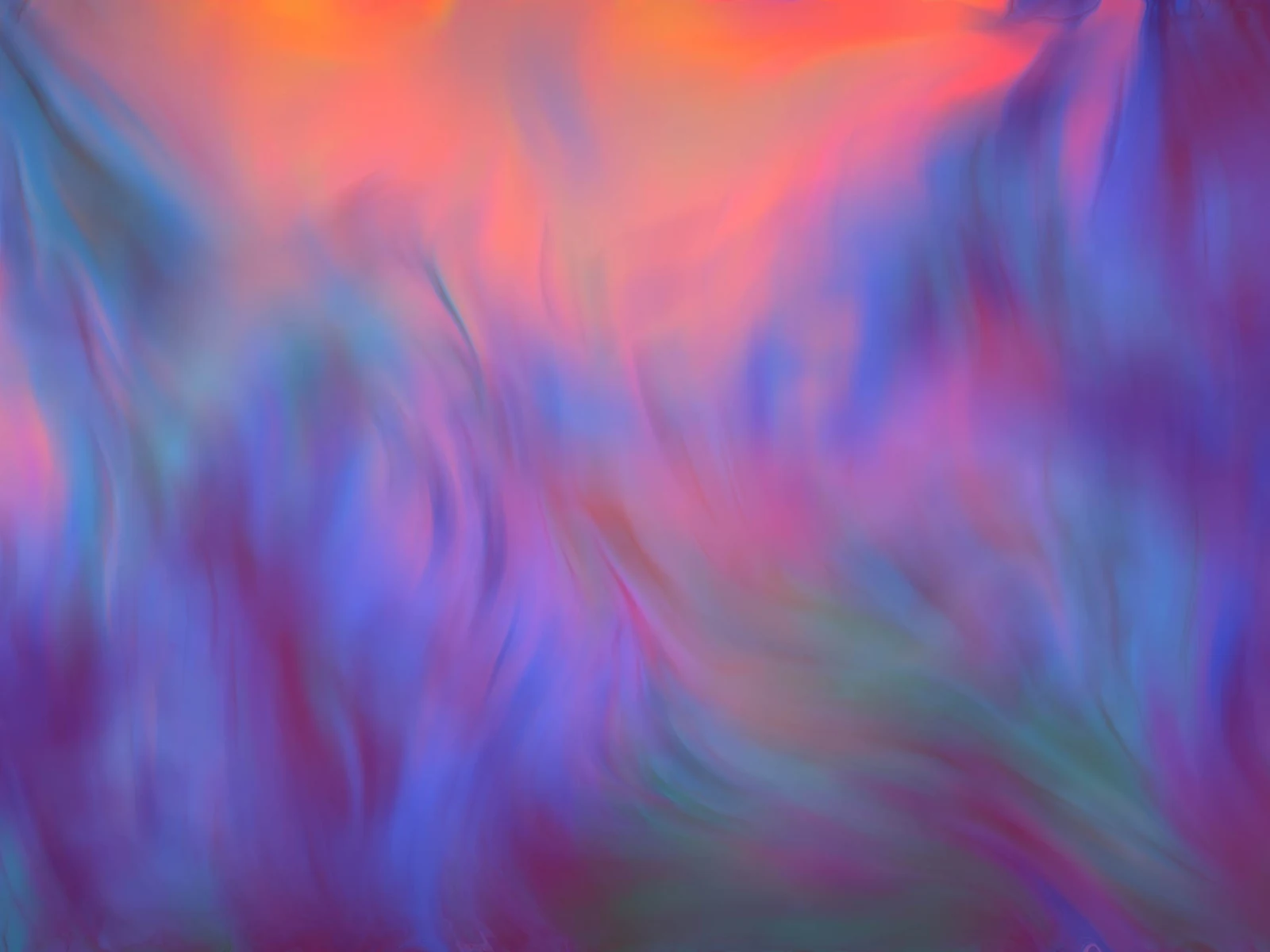
Posterisation, brush-like smearing, dithered banding and layered colour grading rework the raw structure into something warm and hand-made.
Curated colour engine
Hand-designed, field-aware palettes tuned to how colour falls across fractal structure, deliberately avoiding the generic look of generated art.
Seamless loop animation
Compositions animate into perfectly looping sequences, with every parameter driven periodically so playback is continuous and invisible at the seam.
Fully reproducible
Every image is generated from a recorded parameter set, so any result can be reproduced exactly, refined further, or developed into an animated version.
How a piece is made.
Four stages, every one of them computed. There is no source photograph and no painted original underneath.
The field
Each image begins as a fractal field, evaluated for every pixel on the GPU. Julia sets, the Mandelbrot set, Burning Ship, Tricorn and Phoenix each carry their own structural character, and they can be combined. This is the armature the finished work is built on.
Warping the space
Domain-warped flow fields distort that mathematical space, breaking the hard mechanical symmetry fractals are usually recognised by. What emerges instead is drifting veins, layered strata, plumes and all-over textural fields.
The painterly pass
A finishing stage reworks the raw structure with posterisation, brush-like smearing, dithered banding and layered colour grading. This is the stage where the mathematics stops reading as computed and starts reading as pigment on paper.
Colour
Hand-designed palettes, built specifically for how colour falls across fractal structure rather than applied as a generic gradient. This is what keeps the work away from the rainbow signature that marks most generated imagery.
The work.
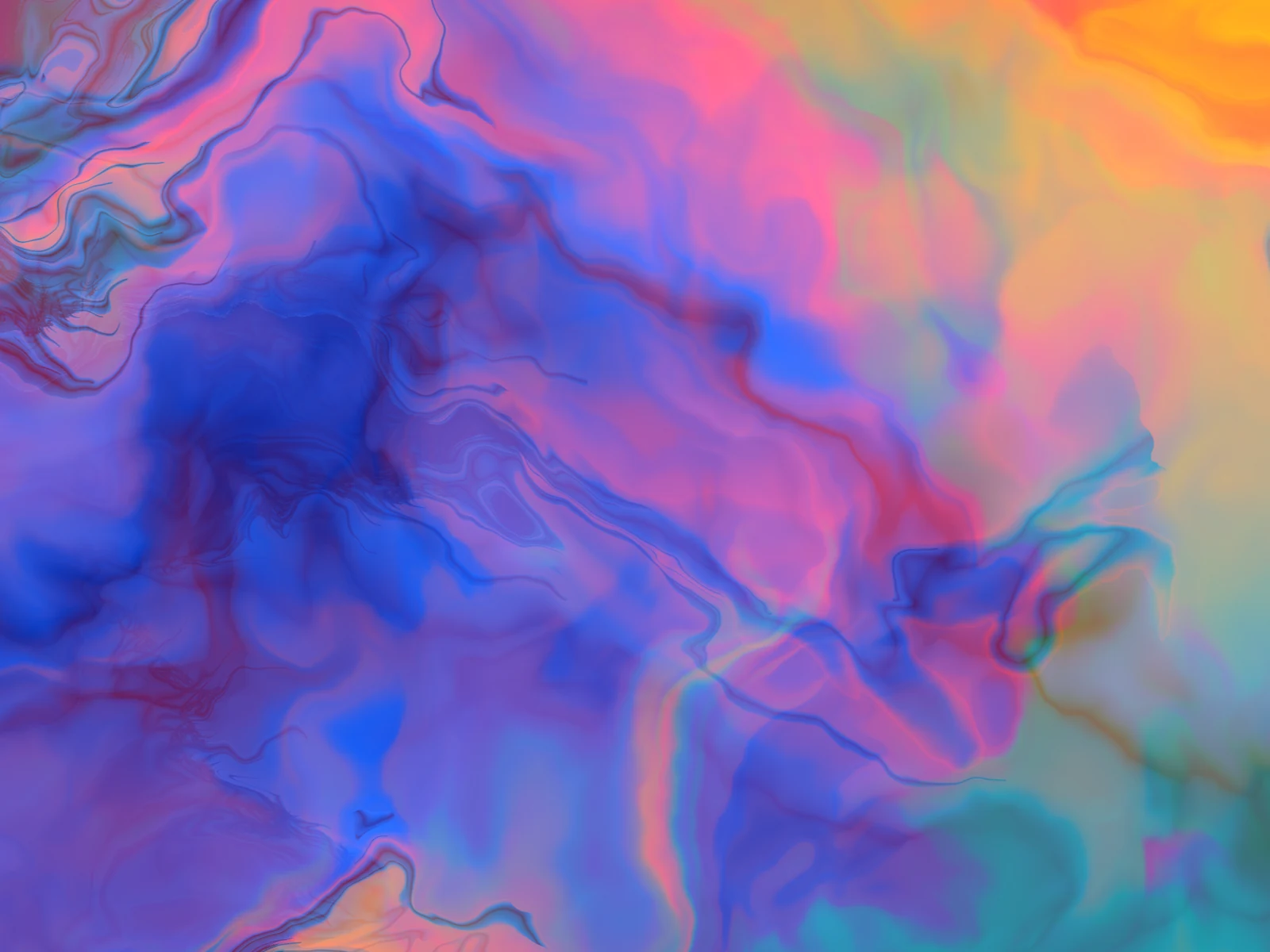


Built for the wall it will hang on.
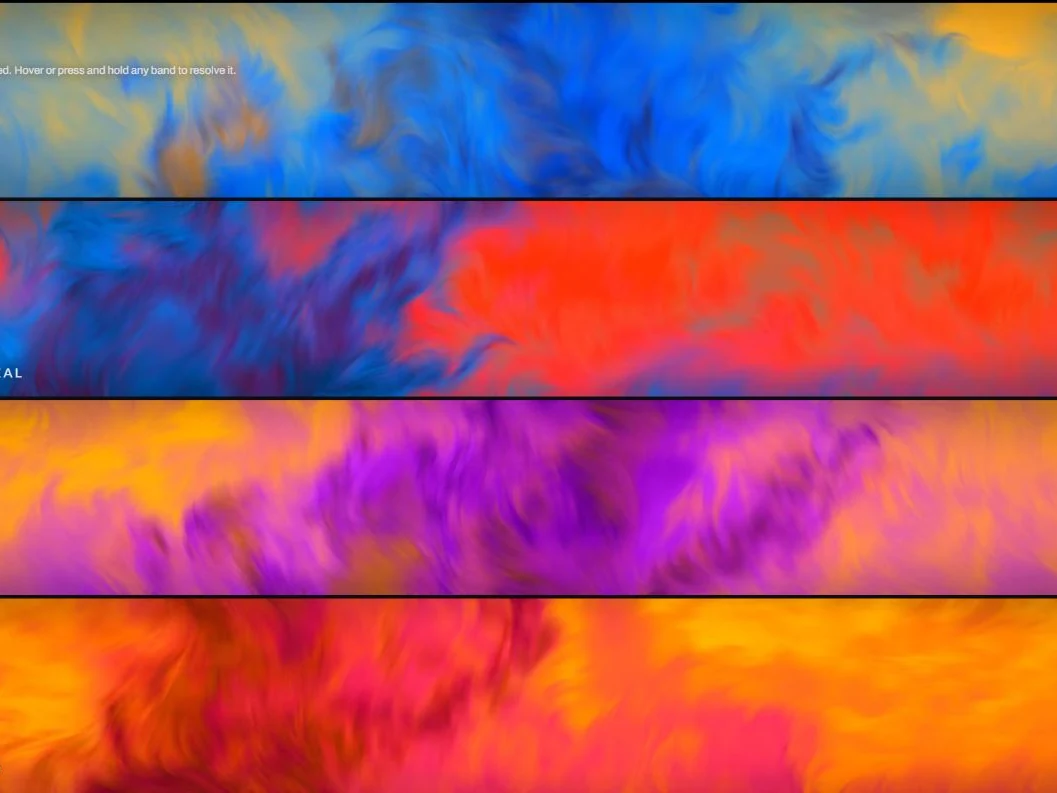
Because every work is generated rather than captured, its dimensions are not fixed at the moment of creation. A piece can be re-rendered to the exact proportions of a given space, at whatever resolution that space demands, without cropping or upscaling anything.
- Ultra-wide to 14,000 × 1,800 and beyond, sized for panoramic and multi-wall projection rather than trimmed down to fit from a screen-shaped original.
- Seamless loops. Every animated parameter is driven periodically, so the first and last frames match exactly. Suitable for unattended continuous display with no visible join or reset.
- Re-rendered in seconds, not hours. Adapting a work to a different wall is a practical decision made during install, not a week of rendering.
- Fully reproducible. Each work is defined by a recorded set of parameters, so it can be reproduced identically, or regenerated at a different scale, years later.
- Silent. No audio component, so it can sit in a shared space without competing with other work.
Computed, not collected.
Every image here is computed from mathematical formulas and a parameter set written by hand. Nothing is derived from a dataset of existing pictures, and no part of the process involves a trained model. The same parameters always produce the same image, which means each work has an exact, recorded origin rather than an unrepeatable output.
Technical detail.
- Type
- A custom desktop rendering engine: a GPU-accelerated raymarching and procedural-shading pipeline.
- Built with
- Python and OpenGL, with the rendering pipeline written in GLSL.
- Fractal formulas
- Julia sets · Mandelbrot · Burning Ship · Tricorn · Phoenix, blended with domain-warped flow fields.
- Composition modes
- Landscapes, plumes, waves and all-over flow fields, freely combinable.
- Output
- Extremely high resolution and ultra-wide aspect ratios, including 14,000 × 1,800 canvases for full-room immersive projection.
- Render time
- Seconds per frame at full resolution, rather than hours.
- Animation
- Perfectly seamless loops, suitable for continuous unattended display.
- Availability
- Not sold as a general-release product. Available for commissioned and site-specific work.
More from the studio.
Planning an immersive piece?
The engine is built for gallery installations, projection environments and panoramic display. If you have a space or a commission in mind, we'd like to hear about it.